Kitchen Culture

Dishwater Zen

FullSizeRender (1)It is 6.22 a.m.  My alarm went off this morning and I woke up mad.  Yesterday was an eternally long day that saw me getting home after ten last night to a jury summons that is supposed to be the first two days when I am out of the country on vacation. (What a great birthday present from my beloved city.)  And today is going to be just as long, just as busy, and leave me just as frazzled.  I am exhausted just thinking about it.

“So,” you may ask, “if you really are this much of a hot mess, why on earth are you posting at 6.30 in the morning?”

I am posting because I just had a five-minute centering moment.

I washed my dishes.

I know some of you busy career women-and-moms just re-read that sentence to check for typos.  There aren’t any.  I love washing dishes.

I grew up like most kids in the suburbs with the standard dishwasher and siblings who argued over who had to load or unload it, and parents who nagged at us to “rinse the dishes before you put them in the dishwasher!  Look at this!  Now there’s food stuck to this that will never come off!”  My first apartment senza dishwasher was like kitchen purgatory.  I was absolutely horrified.

But over the years, I’ve made my peace with the dishes, and I’ve even come to love the process.  (Now, I’m sure if I had three kids under five like some of my friends, I would be willing to kill people for a dishwasher, but I’ll ride this wave while I can…)

I think what I really like about washing dishes is that, for a few minutes anyway, it forces life to slow down.  You can’t really multitask washing dishes.  You can only wash one at a time.

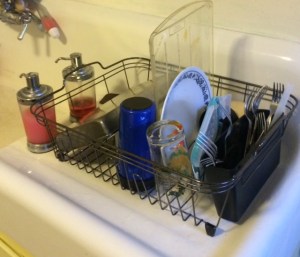
I like the feeling of the warm water.  I like that I feel like I’m accomplishing things as the dishes pile up in the drying rack.   I even like the Tetris-style puzzle that drying rack becomes as I try to stack just one more pan, because I staunchly refuse to get out a towel and dry it when the air can do just as good a job.  If I have a lot of dishes to wash (this happens when I get really ambitious and suddenly realize I’ve got three projects going–one in the oven, one on the range, and one in the CrockPot), I’ll even turn on my Nat King Cole Pandora station and have a ’50’s jam session.

Washing dishes makes me thankful.  Because my kitchen came to be over a series of small purchases, I always find myself thinking about how much I like this pan, that spoon, “Wow, Teflon really is an incredible invention,” what an awesome find those silly “Twelve Days of Christmas” glasses were.  I take the time to love the objects in my life–even though they are just objects–and be thankful that I have them to make my life easier.  It gives me a moment to collect my thoughts and find my footing.

It gives me a moment to remember that my life is actually pretty great–how many great things, activities, and people are in it.  (I mean, how many people can say they actually like their job?)  It reminds me that my current crisis really isn’t one.  That I will survive, and the sun will still be rising in the east when it’s over.

Then I turn off the water and dry my hands.

I have reached Dishwater Zen.
 

Cooking · Culture · Food · Recipes

The Bachelor’s Lunch

I, like many dedicated teachers, avoid the teacher’s lounge like the plague.  I claim it’s because I have too much to do, but really it’s because I don’t have time to be around all the Negative Nancies who delight in complaining about ALL THE THINGS.  I hide out in my friend “Ryan’s” classroom and eat lunch with him, instead.

Ryan and I have very different approaches to our lunchbox experience.  Ryan has a system, he tells me.  He brings the same thing for lunch every day–every day–for a month.  A MONTH.  January was ham sandwiches.  February was salad. Ryan is also singlehandedly keeping the Fruit Roll-Up people in business. (No grown up should eat that many fruit snacks…)  I, on the other hand, bring in the leftovers of whatever I cooked for dinner in the last few days.  Soups, curries, a few well-selected casseroles.  Literally whatever is in the fridge comes to work in the pink paisley lunch bag.

Ryan’s always telling me how great my lunches look and how he needs to “mix it up.”  “Why don’t you just bring leftovers, too?” I ask.  I mean, I am not the first person in history to bring leftovers to work…

That’s when the truth comes out.  Ryan gets away only having to cook about three nights out of seven by scrounging up invites to other people’s houses–so he never has leftovers.  He claims he is just being social.  I maintain he’s free-loading, in part because I am jealous that he actually has that many people willing to provide him with free food on a regular basis, a pattern that I believe is in no small part due to the fact he is a bachelor.  As a bachelorette, on the other hand, I am not so lucky.

Don’t get me wrong.  I like cooking myself.  But it feels unfair. All grown-up persons past college age should be expected to cook for themselves most of the time.

Last week, I was in the mood for something comfort food-y, and tossed together a riff on a pasta bake.  I brought it to work for lunch a couple days in a row, and Ryan couldn’t stop talking about how good it looked, smelled, etc.  He does this sometimes.  He never makes anything I make.  He just asks.  So I tell him how easy it is, berate him (as usual) for being a freeloader and/or eating salad for the 39th day in a row, and then we move on.

But then last night I get a text message:  “How long do you think I should cook the chicken before I put it in my pasta bake?”

Ryan does this–brings me in halfway through a conversation he’s been having in his head like I’ve been there the whole time.  Through a series of slightly confused messages, I deduce that Ryan was so impressed by my pasta bake, he decided he needed to do it for himself.  I feel so proud.  My baby bird is spreading his wings to fly.  I tell him this.  He tells me to shut up, then thanks me for the chicken-cooking advice, and says good night.

Then, fifteen minutes later: “How long did you cook your pasta for?”

Before I can even finish that response:  “Should I use the whole jar of pasta sauce?  Will that be enough?”

Then five minutes after that: “I’m at a crisis!  I’ve only got one 7×11 pan, and I needed that for the chicken.  Should I wash it out so I can reuse it for the pasta bake, or should I use the deeper casserole dish?”

I’m flattered that Ryan actually thinks I care whether he uses the 7×11 or the casserole dish.  (I vote for the latter, incidentally, because I wouldn’t want to wait to clean it out.  He concurs with my expertise.)

I even get photos of the finished product a half hour later.  It’s so funny to me that something like pasta bake is the thing that inspires a person to get into the kitchen.  It isn’t flashy, it isn’t fancy.  But I don’t knock it.  I am a big supporter of anything that gets real life, busy, modern adults into their kitchens and experiencing the cooking process for themselves.

I heard somewhere once that cooking is one of the most fundamentally “human” things about our species.  No animals cook.  Just people.  And when we give up cooking, we give up something uniquely human about us.  It is a skill many of us have lost, and need to fight to keep.

Even Ryan.  Even with a pasta bake.

I glanced at my phone, and the photo of Ryan’s version of pasta bake.  I smiled and texted back:

“Well done, Grasshopper.  Well done.”

If you would like to try my spin on pasta bake, look under my “recipes” tab.


Kitchenware · Misadventures

The Saga of the Wine-Holder-Thingy

A couple of months ago, I went over to a friend’s house for dinner.  It was the first time I’d actually spent any time at her place, so I got the nickel tour: bedroom, living room, bathroom, dining room, kitchen.  She’s a big baker (unlike me.  Please see my post from a few days ago…) so I admired her new, fancy KitchenAid standing mixer and agreed that it was the best color.  (I have learned that KitchenAid owners are sort of like new parents–every mixer is the prettiest and the best.)  I also admired her wine rack.  The rack was actually a series of wine-bottle-sized, wrought iron corkscrews that are suspended from the ceiling.  I told her several times what a cool piece it was, and how great it was in the space and forgot about it.

Well, I forgot about it until I saw my friend again this weekend and she gave me an early birthday present, which was (you guessed it) an identical suspended-corkscrew wine holder-thing.

And I was horrified.

When I was recovering from the shock of what was actually in the box with a big, toothy “thank you” (thank goodness I am a better actress than I am a baker…) my friend said, “I was going to get you this other thing [read: something I actually, really wanted], but then you said how much you liked my wine bottle holder so I thought I’d get you that instead.”

Me and my big mouth.  I did admire the wine rack–in her space.  The thing fits in with my friend’s style and is an interesting conversation piece.  It is cool.  I do love it in her kitchen. I just didn’t ever expect it to end up in mine.

I feel a deeply personal attachment to my culinary space–the way many women feel attached to their wardrobes.  You know, that attachment that prompts comments like, “I love that top, but it just really doesn’t fit with the style I’m going for,” or “I know everyone always says I look great in this dress, but I just don’t feel comfortable in it.”

You have to understand.  My kitchen is a series of rummage sale finds and Goodwill treasures that have combined into a vintage bacchanalia that is essentially an homage to the days when homemade cookies were the norm and kids had to talk on the phone in front of their parents because the phone was still attached to an outlet in the kitchen wall.  I mean, I paid actual, real money for a painted plaster wall-hanging of a bunch of bananas and cherries.  On purpose.  I also (though I love wine) seldom have more than one bottle of it in my house at any given time.

But now, I’ve got this giant, super modern-y, suspended, corkscrew, wine-bottle holder-thingy.  And I have to figure out what to do with it, because my friend was so excited to give it to me and so I know the next time she comes over to my house ,she’s going to expect to see it.  I can’t tell her the truth (i.e. “I don’t want to put it up because it doesn’t match anything and I’m just going to keep bashing my head on it and then getting hit on the back since I’ve only got that one bottle of Cab and the thing swings…”) I’ve bought myself a little time, because I’m moving soon, so I’ll claim I “don’t want to hang it up just to take it down again,” but in the interim, I need to come up with a way to use it that won’t annoy me or offend her.

Right now, I’m thinking maybe an herb drying rack?  Possibly storage for my extra dish towels?  (If any of you, dear readers, have some genius, out-of-the-box ideas, I’m all ears…)

Meanwhile, I’ve learned my lesson.  I cannot overemphasize the importance of word choice when praising other people’s belongings.  And let’s just say I’m planning on phrasing my compliments like this from now on:

“This is so different from my style, but I love this Fill-In-The-Blank-Here in this space!”

China · Cooking · Kitchen Culture · Kitchenware

Rock the Retro

FullSizeRenderWhen I moved back to the United States three years ago, I had to make some tough choices about what was going to go into the three suitcases I got to bring with me.  Though I love cooking and the “food” experience, very few of my kitchen items made the cut.  I left behind, among others, my Aeropress coffeemaker and beloved immersion blender.  Only four cookbooks made it back Stateside intact.  The rest were ruthlessly rooted through by my roommate and I as we cut out any recipes we thought we may ever make and tossed the dross.  (When you’re trying to get four profoundly formative years of your life down to 150 pounds, you can’t afford to be kind.)

An often overlooked side effect of spending your late twenties having this life-changing experience in the developing world is that you get back to the U.S. with like $600 in your bank account–a bunch of money for China, not a bunch of money for the States.  So I had to go about rebuilding my life on a shoestring.

You don’t think about how all the stuff you’ve amassed in your kitchen cost an accumulative bundle because most people’s kitchens are slowly populated with every spoon on the planet over a course of months or years.  (Lots of people also get cool things called “wedding showers,” of which I didn’t have the benefit, but I digress…)

So what does a poor, at the time only partially-employed teacher do?  She becomes best friends with her friendly neighborhood Goodwill, that’s what.

This is the way I got my dishes, silverware, mixing bowls, casserole dishes, pans, pots, mixing spoons, storage containers and measuring spoons–in fact, as I catalogue my kitchen in my head, I can think of only three or four things that were actually new when I bought them.

It means I saved a bunch of money.

It also means my kitchen paraphernalia has a strongly ’70’s gold vibe about it.

I’m now in a much more stable financial place, and could probably afford to upgrade a lot of my Poor Girl Kitchen.  I could replace my mismatched kitsch-fest with something chic.  But I realize I’ve grown attached.

Nobody else has my old, white-with-royal-blue-trim Correllware.  I never have to worry about anyone “accidentally” taking my aqua-blue Pyrex bowl home from a potluck by mistake.  I am the only person I know under 60 who can claim her kitchen counter is graced by a vintage, 1980 CrockPot with orange flowers on it and a bread making canister.  (Yes.  I can, in fact, make bread from scratch in my CrockPot.  You can be jealous.  It’s okay. I understand.)  I also don’t know anyone else who can claim her salt and pepper shakers were made in West Germany (back when West Germany was still a thing…)

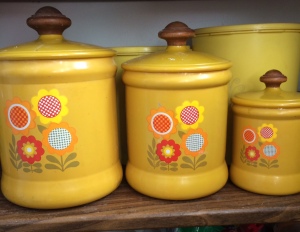
My kitchen has history.  Generations of cooks and bakers are represented in my kitchenware–my 1950’s Pyrex, my 1960’s flour and sugar canisters, my 1970’s Tupperware, my 1980’s CrockPot, my 1990’s lemon-shaped egg timer–all the cooking fads, all the kitchen disasters, all the families who gathered around tables and stood around  while people washed dishes, are all represented and remembered my little kitchen.  I like the one-of-a-kind uniqueness of it.  My kitchen has the “be your own person” personality we always tell kids is important but so often shy away from in our adult lives.  And I think that counts for something.

So you can keep your fancy-shmancy, polished silver coffee storage containers.  I like the green pepper and squash design on my old glass one just fine.

Cooking · Food · Misadventures · Recipes

Desperation Depression Cake

I like baking in the philosophical sense.  I like the idea of baking–the whole Tollhouse cookie, Pillsbury Doughboy image of cookies and biscuits being pulled out of the oven, a toasty golden brown, fluffy, and identical in size and shape, usually while wildly smiling and suspiciously clean, blonde children stand watching, on the ready.  Me in an old sweatshirt, cursing under my breath when I realize I don’t have any eggs–something I only realize after I’ve creamed the butter and sugar and added three cups of flour–does not fit this image.

Please understand.  The scene of an angry me storming around my kitchen because I have to go to the store now is not a “one time only” showing.  This scenario unfolds with very little variation whenever I am possessed of the random impulse to bake.  I never have eggs.  You think I’d learn to check for them before I start, but I don’t.  I start recipes.  I don’t have eggs.  It’s a universal given on the level of death and taxes.

Then one day, desperately searching the internet for a dessert recipe that didn’t require me to go to the grocery store, I discovered the gem that revolutionized my “Last Names Beginning with A-H Bring a Dessert” life:  THE DEPRESSION CAKE.

Don’t panic!  This cake gets its name from the three holes (depressions) you make in the dry ingredients to pour various liquids into–it does not cause, worsen, or is in any way related to any medical condition (except maybea sugar coma if enough is consumed?)

I honestly don’t remember where I found it anymore, or I would totally give the webpage its due, because this cake is truly amazing.  Not only is it a good “take to a party” 9×9 size, (since nobody wants to look like a pig eating half a cake straight out of the pan when there are other people present,) it’s light, fluffy, moist, and generally delicious.  You also can mix the whole thing in the pan you bake it in, so there are aren’t a thousand bowls to wash.

IMG_0484
Behold, the cake! (And now you know why I’m a teacher, not a food photographer…)

And (even better!) no one who eats it will EVER guess that the recipe calls for no butter, no milk, and (most importantly in my case) NO EGGS.  Unless you tell them, and I do, because I think this recipe is genius–and also because then people of the vegan persuasion can’t make everyone else feel guilty for eating dessert without them.
It’s now my party go-to, because, let’s be honest, you tell people you made a cake “from scratch,” and most of them will elevate you to a culinary place somewhere between Julia Childs and Betty Crocker.  They will never know that this recipe is basically one step up in difficulty from a grilled cheese sandwich.  The way I see it, what they don’t know can’t hurt them.   Happy baking!

(If you’d like to try the Depression Cake for yourself, you can check it out under my “recipes” tab.)

Teaching

The Gift

I have a student who we’ll call “Jordan.”  Jordan is a sixth grader who began our relationship by walking up to me the first day of choir and informing me that he “hated singing” and “didn’t like music.”  I talked him into waiting two weeks before he quit.  He told me that was fine, but he was still going to be out of there as soon as he could.

Let me try to build you a visual of Jordan.  He’s as cute as a bug’s ear, a little pip-squeak of a kid whose voice change and growth spurt are nowhere in sight.  (As a choir teacher, one comes to think of puberty strictly in terms of the effects it has on the human voice and how many part threes one’s likely to have by June.)  If he were an animal, he’d be a squirrel–cute and likable with a certain manic energy than can overwhelm you if you’re not ready for it.  He can be frustrating, but I just can’t stay mad at him for long because he’s so earnest and hard-working and he’s so darned cute.

Obviously, Jordan never quit choir.  In fact, he is one of my choir officers now and one of my “specials”–the kids with whom you feel that special, Teacher-Student bond.

Hanging on my wall, I have a Darth Vader he made me out of those little plastic beads you melt together with an iron.  He hangs around at the end of class to talk to me.  He tells me about how he leveled up in his favorite video game.  (I understand zero percent of what he’s talking about, but I listen and congratulate him, anyway.)  He asks me about what he should do if a girl likes him, what should he do to tell her he doesn’t like her because he likes someone else?  He tells me about he’s going to see The Force Awakens for the fifth time.  And today, out of the clear blue sky, in the middle of a conversation about how his mom is “making him do X” because she is a good mom, and that’s what moms do, he says, “Well, my first mom wasn’t doing a good job.  That’s why I have my new mom now.”

“Oh,” I say, not quite prepared, as so often is the case with kids, for the suddenly deep water we’re treading.  “I didn’t know you were adopted.”

“Yeah.”

“Well, I’m glad you have a good mom now.”

“My brothers and sisters weren’t doing good things, either.  That’s why they live so far away.”  Far away, I later find out, is Oregon.  I don’t ask what he means by “not good things.”

“So, how old were you when you were adopted?” I ask, figuring he must have been four or five, since he clearly has some memories of his biological mother.

“I got adopted when I was eleven.  That’s why I moved to Wisconsin.”

My heart hurts for this little guy, always so earnest and excited for class, trying hard to follow the rules of the rehearsal and expects them of the people around him.

“Is that weird for you sometimes?” I ask.

He shrugs, “A little.  It was kind of weird because my mom, I used to call her ‘Tracy,’ but now I just call her ‘Mom.'”

He doesn’t elaborate further, and two minutes later, he’s pestering me to get him a frappe at McDonald’s as I write him a pass to his next class, telling me all about how his sister in Oregon bought him a new video game that is in the mail, Miss Donaldson, and it’s killing him because he has to wait for it to get here.  He’s told me what he wants me to know, and now he can move on, as he bounces out my door and down the hall.

As I listen to the door close behind him, I pause.  As a teacher, I can check the records and could probably have figured out Jordan’s history, but that’s not the same as having a student confide it in you.  I think one of the reasons I like Jordan so much is because he is a student who really needs me, the way my overseas students did, and in a way my American students do not.  He needs me to listen.  He needs me to know he’s adopted.  He wants me to tell him he can do it, that he shouldn’t give up.  He wants me to be part of his little life.

And I know that is a gift.

China · Culture

Telling my story

This is not actually a “first time” story, so much as a “first time in a long time” story.

It is difficult to explain to people who have spent their whole lives in the comfort of their home cultures how profoundly living abroad can change you.  When I first moved back to the United States, I spent a lot of time trying to get the people who knew me and the people I met to understand how completely this revolutionized everything about how I thought and how I saw the world.

And while those people to whom I’m closest made a concerted effort to understand and appreciate it because they cared about me and they knew that cared, the honest reality is that most people really don’t.  It’s so other and foreign and they write it off with the blunt stroke of “something crazy that other people do,” or (worse) “Oh…well, that’s nice.”

So as time’s gone on, and my Chinese-isms have become increasingly hidden beneath the layers of me who once again understands people don’t pick up bowls off the table when they eat and that it is socially unacceptable to wander into the street without checking for cars first, I have stopped feeling compelled to share my story.  It is no less important or defining, but I’ve found that it’s something that makes me unappealingly different and it’s easier to let people think I’ve “always been from around here.”

But last weekend, I was working with my choir director on the pronunciations for several Chinese folk songs for an upcoming concert (songs that, singing them, got me a little misty–but that’s a tale for another day,) and the whole “So, how did you end up in China and what were you doing there, anyway?” ended up on the table.

And so, for the first time in a long time, I really told my whole story, start to finish, with a lot of the anecdotes I’ve learned to leave out, with all of the parts that Americans struggle to hear–that there are times when I desperately miss my China home, the students I left behind that I know I will never replace, relationships I had that are impossible to have in a mono-cultural setting.  For the first time in a long time, I told my story.

And for the first time in a long time, I remembered that part of myself.

Culture

What if…

“What if?” is a question with more layers and facets than probably any other stock question with the exception of “Why?”

It can be an incredibly ridiculous question.  (And, as a byproduct, annoying.)  My work with children makes me an expert in this category.  My students are famous for questions on the level of “What if dinosaurs attack the school during a fire drill?  What exit would we take then?”  Or “What if someone forgets their recorder for the recital today?”  These kind of questions usually warrant answers like:  “We’ll deal with the T-Rex rampage when we get there–your job is to listen to the adults around you,” and “But, Dejah, you didn’t forget your recorder–you’re holding it right now.”

“What if” can also be a lament to missed chances.  “What if I had come up with some really great and witty response when that guy in the grocery store line smiled at me?”  “What if I were more ‘normal’ and I didn’t have to show everybody who I really am all the time?”  “What if my sister and I connected on any level and I felt like I had a sister and not just a person I know whom I alternately wildly envy and am called on to parent and counsel?”  I don’t like to spend too much time in this place–a person could drown in questions like this.

But most of all, “What if” is a dangerously profound question.  “What if I hadn’t met Jesus when I was four?”  “What if I had listened to everyone who told me I shouldn’t go into music?”  “What if I gave in to all those voices that say I’m not the right this and not enough that?”  “What if I hadn’t gotten on that plane and flown halfway around the world to take a job that completely changed my life?”  These are the questions that reveal the deepest parts of the soul, those secret places that makes us who we are, the defining moments that we can never and would never take back.

Because these are the “What ifs” that combine into the person I am.  These are the experiences that I share and those I don’t.  These are the “What ifs” that make me say, “Yes, this is who I am.  And I wouldn’t change it.”

China

Roots and Wings

My route to visit my friend in Oklahoma took me, incredibly enough, directly through my childhood hometown.  We moved the summer before I began the eighth grade, and without any family in Marion, Iowa, there was no reason to go back and visit once we left.  So I hadn’t been back in over fifteen years.  Completely thrilled at the prospect of seeing “the old homestead,” I rerouted my trip a little and added an extra hour and a half to what was already a fifteen hour drive to eat at one of the best pizzerias I’ve ever been to (If you’re ever near Marion, make sure you stop by Zoey’s Pizzeria–their Chicago-style deep dish is absolutely amazing!)  and drove wanderingly (and, in all probability, dangerously) around the streets to see what I remembered.

I remembered, as it turns out, a remarkable amount.  I almost killed myself in a very Chinese traffic move of veering across three lanes of traffic in fifty feet to make a right turn when I realized I was right by my old subdivision.  I drove up and down the streets, stopped and took pictures of our old house, and the tree that my mom planted 21 years ago when my little brother was born…needless to say, it’s huge now!  While there were a lot more buildings, businesses had changed, but the neighborhood itself was remarkably the same.  It was like we’d left just a few days ago, not 15 years.  After I’d taken my pictures, and before the neighbors could call the police about some crazy woman, snapping pictures with her cellphone and giggling inexplicably, I headed out and got my deep dish pizza at Zoey’s, then made my way back onto the Interstate.

As the miles started whizzing by again, and I watched the landscape, no longer the rolling, Kelly-green hills that the past fifteen years have taught me to think of as “home”, but the vast, unending expanse of the Great Plains flash by my windows, I started wondering how different my life would have been if we’d never moved.  If I had spent the entirety of my living memory calling one place “home.”  If my root ran deep in this place that was now both nostalgic and incredibly foreign.

I have always had a wanderer’s soul.  I have never felt a strong pull to a specific place.  I have ties to people–to family, mostly, though on rare occasion, friends, as well.  I have always dreamed of going far, exploring, learning new languages and cultures, seeing the places and things I’ve only ever read about in books.  I have always dreamed of wings.  To me, the idea of living in one place for generations, of living and dying in the same town, sounds horrible and cloistering.

But walking down memory lane, reliving old memories on the admittedly unexceptional streets of Marion, Iowa, I wondered if maybe there is merit in those roots, if living a small, but extraordinarily connected life has its own merits that I have missed in my quest to fly.

I think about my siblings, all of whom remain within an hour of my parents’ house, and I know that we are fundamentally different.  They, more than I, am tied to the land where I spent my adolescence and they, their childhood.  They have roots that are deeper than mine.  For them to pick up and leave the way I did would be more difficult.  The roots they would have to pull up would be significantly more painful.

Which is better?  I don’t know.  I think some of what I face in the next year is trying to balance the wings of my soul with that need for, and desire for roots, for ties.  Trying to figure out how to marry two ideas that are, fundamentally, different and at odds.  To make sense of roots when God has given you wings.


China · Culture

Road Trip!

Nothing is more American than a road trip.  It’s all that Oregon Trail, Route 66, “See the U.S.A. in your Chevrolet” nostalgia, maybe.  Or maybe we’re just a country of wanderers.  At any rate, it’s America.  The car, the open road, the speed.  I mean, how many American “coming of age” tales involve taking road trips (be it with best friends, strangers, or family members to whom we are not speaking)?  The car on the interstate says America.

And tomorrow, I am going to make an effort to rejoin this great American pastime.  I will load up my little, black Civic with a tiny suitcase, a cooler, and an unholy number of shoes, and head out on an 800 mile journey to visit my soon-to-be-married best friend in Oklahoma for the weekend.

And I am terrified.  I have done very little real driving in the past four years.  In China, the most dangerous thing I rode was a bicycle.  If I wanted to go somewhere far away, I had to walk a half mile to the bus stop, or embark on the impossible task of hailing a cab.  It has been a long time since I really drove on American roads.  I am terrified that I’m going to drive like a Chinese person–turn on my right blinker then turn left.  I have actually sat at stop lights in the U.S. and thought, “Is that a law here, and do I have to follow it??

Let’s just say, I keep reminding myself that in this country, it is illegal to simply put your car in park in the left lane so you can answer the phone.

But, I’m excited, too.  I have developed a weird desire to stop at little greasy spoon diners and try whatever is the “house specialty.”  I don’t know if, when I was living in China,  I watched Cars too many times when I was feeling homesick or that Food Network binge I went on when I got back did me in with the Diners, Drive-Ins and Dives marathon. But it’s there.  I can’t fight my lust for Americana.

Life abroad has made me love the beauty and lay of the land like I never did before.  I love to just get in a car and drive.  I take backroads to Walmart or the grocery store and I avoid the interstate whenever possible.  I really, truly, enjoy just seeing America–see little towns and cities and farms and forests and everything else.  Everywhere I have traveled to in my life has its own, special kind of beauty.  But the more often I come home, the more I am convinced that this land I call “home” is exceptional.  It’s lush and diverse.  And tomorrow, I’ll strike out on my own to see it again.  Tomorrow, I’ll be driving down the road, cranking up Life is a Highway and experiencing my homeland again for the first time.