I like cookbooks. A lot. As in, I actually read them, cover to cover, for fun. As in, I own 44 (I literally got up from this computer to count them), and I have cooked multiple recipes out of 34 of them (I also just counted that). As in, one of my favorite parts of the week is sitting down with a stack of randomly selected cookbooks to pick recipes and make my grocery list. As in, I have been known to check cookbooks out from the library. On purpose.
Most of my cookbooks are finds from bargain bins, community book sales, and charity shops. Nearly all of them had previous owners, and I think I only paid cover price for two. Like many things in my life, I believe in recycling.
Whenever I go to a Goodwill, I always make sure to do a flyby of the cookbook section. I like reading the titles and seeing what’s there. You tend to see a strong representation of cookbooks from last year’s diet “miracle” (Atkin’s, South Beach–I’m sure the Paleo collection will be in season in the next year or so…) and there are always at least four copies of that Oprah cookbook, In the Kitchen with Rosie. (I guess every person in America must have owned at least five copies in 1998.) Through my perusal-ing, I have gathered that, in the early ’80’s, people believed that the secret to healthy living was removing all the fat from all the things (titles along the line of Feed Your Family the Fat-Free Way, and Living Healthy: Old Time Flavor without the Fat). It was also widely accepted, apparently, that it was only a matter of time before microwaves completely replaced the traditional oven (There is usually an entire shelf dedicated to things like Microwave Miracle!: 101 Microwave Oven Recipes for the Modern Cook).
I usually end up leafing through the oldest cookbooks there, myself–the ones from the ’60’s and ’70’s. I like getting the window into a world that is so different than my own–a world where kids still took homemade birthday treats to school, getting together with friends meant someone was going to “entertain,” and Betty Crocker’s marketing team had not yet convinced America that from-scratch cakes are so much more difficult and complicated than ones from a box. (They aren’t, incidentally.)
The recipes in these faded books are a lot better, by and large, than their modern counterparts. I think it’s because when these cookbooks were written, people still, well, cooked. Today, most cookbooks have recipes that call for about a million ingredients, at least a dozen of them impossible to find if you don’t live in one of the Food Capitals of the World (New York, London, Paris, L.A.), let alone Smalltown, America. I mean, you can only cook recipes out of a book like Plenty (a truly beautiful cookbook–it’s like food porn) if you have about three to four hours, decent skill, a professionally outfitted kitchen, and access to some crazy ingredients. And that book was a New York Times bestseller–a bestseller! I’d wager this cookbook sits in cabinets all over America with pristine pages while their owners eat Chinese take-out for the third time this month.
Most people I know maintain diets that include a significant amount of restaurant food (be it from fast food, delivery pizza, or sit-down restaurants) supplemented heavily by premade food that we just heat up (chicken nuggets, burritos, frozen pizza, pre-portioned frozen dinners). We live in a culture where we watch other people cook food on television while we pull the plastic film off the top of a Lean Cuisine. We, as a culture, honestly believe that cooking is a thing reserved for professionals, retirees, and rich women with nothing better to do.
Let me say that in another way:
We have bought into the lie that cooking–the act of going into your kitchen and making something from scratch–is a luxury the average American can’t afford.
That doesn’t sit well with me. It bothers me that we think we’re “too busy” to do something that makes us so fundamentally human. It bothers me that we’ve let marketing campaigns convince us that we “can’t possibly” make a pizza by ourselves or that we’re “too busy” to make chicken noodle soup that doesn’t come from a can. I think we’re better than that. I think I’m better than that. I think you’re better than that.
So prove the marketing people wrong. Take back the kitchen from the people on T.V. Be a renegade.
Cook dinner tonight.
 I have a confession to make.
 Kitchens are the heartbeat of any family. It is where you pour another cup of tea to fend of an impending cold. It is where you pour another cup of coffee and sit down to listen as the people dearest to you cry at the kitchen table. It is where Grandmas and Grandpas cement their place as better than parents (because every kid knows there is always dessert at Grandma’s), countless hours of homework are done, important talks happen, grievances are aired, people laugh and cry and fight and make-up.
 “thing.” It’s not exactly the same, but I saw it and The Memory summoned itself up. I remembered that big, airy, white, old-fashioned kitchen. I remember looking up and seeing my mom and grandma talking about something–I’m sure it was probably the funeral. I remember the world seeming a lot bigger.
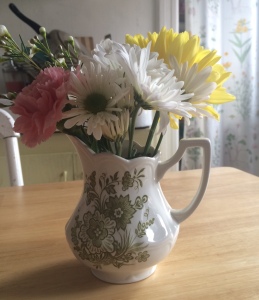 I love flowers. I fantasize about having a big garden where I can just walk out into the yard in the summertime and cut a giant bowl of hydrangea or peonies or daisies–like you always see on the covers of those “Home and Life” style magazines in the grocery store line.
 rice and coffee