Cooking · Culture · Kitchen Culture

Kitchen Renegade

I like cookbooks.  A lot.  As in, I actually read them, cover to cover, for fun.  As in, I own 44 (I literally got up from this computer to count them), and I have cooked multiple recipes out of 34 of them (I also just counted that).  As in, one of my favorite parts of the week is sitting down with a stack of randomly selected cookbooks to pick recipes and make my grocery list.  As in, I have been known to check cookbooks out from the library. On purpose. 

Most of my cookbooks are finds from bargain bins, community book sales, and charity shops.  Nearly all of them had previous owners, and I think I only paid cover price for two.  Like many things in my life, I believe in recycling.

Whenever I go to a Goodwill, I always make sure to do a flyby of the cookbook section.  I like reading the titles and seeing what’s there.  You tend to see a strong representation of cookbooks from last year’s diet “miracle” (Atkin’s, South Beach–I’m sure the Paleo collection will be in season in the next year or so…) and there are always at least four copies of that Oprah cookbook, In the Kitchen with Rosie.  (I guess every person in America must have owned at least five copies in 1998.)    Through my perusal-ing, I have gathered that, in the early ’80’s, people believed that the secret to healthy living was removing all the fat from all the things (titles along the line of Feed Your Family the Fat-Free Way, and Living Healthy: Old Time Flavor without the Fat).  It was also widely accepted, apparently, that it was only a matter of time before microwaves completely replaced the traditional oven (There is usually an entire shelf dedicated to things like Microwave Miracle!: 101 Microwave Oven Recipes for the Modern Cook).

I usually end up leafing through the oldest cookbooks there, myself–the ones from the ’60’s and ’70’s.  I like getting the window into a world that is so different than my own–a world where kids still took homemade birthday treats to school, getting together with friends meant someone was going to “entertain,” and Betty Crocker’s marketing team had not yet convinced America that from-scratch cakes are so much more difficult and complicated than ones from a box.  (They aren’t, incidentally.)

The recipes in these faded books are a lot better, by and large, than their modern counterparts.  I think it’s because when these cookbooks were written, people still, well, cooked.  Today, most cookbooks have recipes that call for about a million ingredients, at least a dozen of them impossible to find if you don’t live in one of the Food Capitals of the World (New York, London, Paris, L.A.), let alone Smalltown, America.  I mean, you can only cook recipes out of a book like Plenty (a truly beautiful cookbook–it’s like food porn) if you have about three to four hours, decent skill, a professionally outfitted kitchen, and access to some crazy ingredients.  And that book was a New York Times bestseller–a bestseller! I’d wager this cookbook sits in cabinets all over America with pristine pages while their owners eat Chinese take-out for the third time this month. 

Most people I know maintain diets that include a significant amount of restaurant food (be it from fast food, delivery pizza, or sit-down restaurants) supplemented heavily by premade food that we just heat up (chicken nuggets, burritos, frozen pizza, pre-portioned frozen dinners).  We live in a culture where we watch other people cook food on television while we pull the plastic film off the top of a Lean Cuisine.  We, as a culture, honestly believe that cooking is a thing reserved for professionals, retirees, and rich women with nothing better to do.

Let me say that in another way:

We have bought into the lie that cooking–the act of going into your kitchen and making something from scratch–is a luxury the average American can’t afford. 

That doesn’t sit well with me.  It bothers me that we think we’re “too busy” to do something that makes us so fundamentally human.  It bothers me that we’ve let marketing campaigns convince us that we “can’t possibly” make a pizza by ourselves or that we’re “too busy” to make chicken noodle soup that doesn’t come from a can.  I think we’re better than that.  I think I’m better than that.  I think you’re better than that.

So prove the marketing people wrong.  Take back the kitchen from the people on T.V.  Be a renegade.

Cook dinner tonight.

Misadventures

Stories of a Not-Quite-Right Quilt

IMG_0509I have a confession to make.

I struggle to follow directions.

Patterns, maps, guidelines, recipes–you name it.  If it has a certain way it should be done, chances are I have not done it this way.  Usually, it’s not anything major, and it’s not like I do this for any important reason.  I’m not trying to “stick it to the man,” or prove my frontiers-woman spirit.  No, mostly it’s because I just can’t be bothered. In my mind, it legitimately seems like less work to figure it out on my own as I go along than to take the time to look it up on youtube.

It usually happens like this: I see a [skirt, cable-knit hat, flower arrangement, gift basket] and say, “I bet I can do that.”

Because of this boundless belief in the power of creativity, I have made my own sewing patterns out of brown paper bags by tracing around myself.  I have knitted hats by looking at one, knitting for a while, then holding up what I’ve done to the one I bought.  I have (no joke) given myself first degree burns hot gluing myself into costumes.  But don’t worry.  “I’m sure I can figure this out.”

Take, for example, the quilt I’m wrapped up in right now.  It is a quilt in only the most general of senses (no intricate stitchwork here–it can only qualify as a quilt because every four squares or so, I sewed little x’s of yarn through the layers.)  I made this quilt because of one just like it that a family friend made for my brother.  I snatched from my parents’ house and took it with me to college–no one has ever commented on its disappearance.

I can still remember the day when, randomly, I looked at that quilt and thought “I can do that.”  So, with nothing but the quilt and my conviction I could figure it out, I went to the store and bought a bunch of arbitrary pieces of fabric.  I measured the basic size of the quilt by holding it up to my arm (I couldn’t be bothered with a tape measure.)  Then I cut out the pattern for the squares (again, out of a brown paper bag) eyeballing it from the original.  I didn’t piece it together the way you’re supposed to (one at a time–making four small squares into a medium size square, then four medium sized squares into a big square, and so one.)  I sewed a bunch together in huge strips.  Half the time I didn’t even pin them first (again, too much work.)

As a result, my quilt wasn’t perfect.  The squares didn’t all line up in perfect rows and columns.  Some are a little off-set.  You need to know that I can be a total perfectionist.  But I also didn’t really want to have to rip everything apart and re-piece the stupid thing. I really thought about it–Perfectionist Me warring with the inner-pragmatist that thought, “Does this really matter?”

In the end, I decided that it was okay for my quilt to be not-perfect.

Now, before you decide to hate me for accepting mediocrity, give me a chance.  Anyone who knows me knows that I like to do things well.  I demand a lot of myself professionally, I demand a lot of my students.  I work hard.  I am ambitious.  However, I have also learned that if you have to have every little thing exactly “so,” you will not only lose sight of the end game, you will also drive yourself insane.  We can learn a lot from imperfect experiences.

I work hard to impress on my students the idea that not-quite-right final products mean we’re on the road.  That what we learn from the failures, the flops, the funny looking hat, the out of tune chord, the not-straight quilt are all stops along the way.

I have learned a lot by doing it once, deciding it doesn’t work, tearing it out and doing it again. Sometimes, it’s worth it to me to re-do it–because it’s something that’s important.  Sometimes, I decide that the little foibles of whatever I’ve made are not worth the effort–and that’s okay, too.

And I think to be a healthy person, to live a joyous life, we have to approach it that way–not everything is equally important.  We have to learn to pick our battles.  We have to decide which projects are worth staying late to make perfect, and which we can make the best we can before dinner.  We have to decide which activities are worth making room for, and which are worth skipping.  We have to decide which relationships to make peace with and leave behind, and which to put in the hard work of mending.

We have to decide which seams are worth ripping out and trying again.

Culture · Kitchen Culture

A few more Come-on-over’s

Tonight, I had to leave work before I got everything I needed to done.  I actually had to bring work home with me–something I NEVER do.  I had to skip my usual trip to the gym to break in brand-spanking-new running shoes.  (Don’t judge me; it is wet outside.  You can’t totally ruin new shoes in the rain the very first time you wear them…)  I cleaned my bathroom.  I washed every dish in the sink.  I dumped the classic “Sour Cream and Onion Soup Mix” dip out of the plastic tub and into an actual bowl.  I even swept my entire apartment.  (I live in a converted Victorian house.  Sweeping is the most hopeless cause since St. Jude took them up–dust literally comes out of the walls…)  I got out a clean dish towel.  I am now writing this blog and I am still wearing real pants, rather than the preferred leggings or pajamas.

I have done all of this because I have friends coming over for dinner tonight.

At moments like this, I hanker to just call everyone and say, “Let’s just meet at the restaurant across the street…”  It would be so much easier.

Long ago (before Christmas), “Kelly,” “Morgan,” and I did this exclusively.  We had a few quiet restaurants that we’d frequent every few weeks when we all could get together.  It was really a very pleasant state of affairs, if you must know.  But then I got the bright idea that we should use our aligning spring breaks to go somewhere on vacation together.  (I believe my exact specifications were: 1. Someplace warm.  2. Someplace where I can those floofy drinks with umbrellas in them.  3.  Someplace where no one will ask me any questions that begin with, “Hey, Miss D, can I…” for five days.  A girl has to have her standards.)

And rather than what usually happens–agreeing it’s a great idea and then doing nothing about it–the two of them came over to my house before the new year and we actually bought the tickets for the Caribbean.  It’s very exciting (especially as we are now in the single digits until we leave…)  However, we’re all teachers.  We’re not exactly made of money.

So we started skipping going out and passing around who hosted dinner.

The hostess is responsible for the entree  and usually one (easy) side.  The other two bring sides or dessert.  It is traditionally BYOB.  Of course, sometimes this division of labor backfires.  Kelly was hosting last time and said she had it all covered.  All we needed to bring was what we wanted to drink, “unless we wanted to bring something else, too.”  We ended up with four bags of chips, a pizza, a batch of cookies, a cake, and ice cream.  Clearly, we struggle with scale.

I actually like this arrangement a lot more than I had originally thought.  We still end up making those things you never make when you’re a one (pizza, burgers–I’ve got pulled pork simmering in my CrockPot as I write this…), plus, you’re in charge.  You don’t like that song that’s playing?  No problem.  It’s my Pandora–it’s gone.  You can literally sit at the table for four hours and not feel guilty.  You don’t have to keep ordering drinks and desserts and things you don’t want just as a way to apologize to your waiter that you’re still at this table on a Friday night.  Falling asleep halfway through the movie is a totally acceptable life choice.

Plus, I like seeing people’s houses.  I like seeing how each house has a personality as unique as its owner.  As an aside, let me here insert I am secretly suspicious of people who don’t decorate their living spaces.  There is no bigger red flag than a bunch of blank walls.  I’m always thinking things like, “What’s wrong with you?”  “Are you a cardboard human?”  “Do you like living in a hotel room?”  Or, when I’m feeling particularly ‘judge-y’, “Are you some sort of sociopath?”

Fortunately, my friends do not fall into this category.  Morgan, for example, has the most coordinated apartment I’ve ever seen.  The beach theme isn’t just in the bathroom–it flows seamlessly through every room in the entire house.  Kelly still has a couch that looks like she got it in college, because she’s been too busy buying the five million books she has in bookshelves all over the place.  My apartment is channeling “found beauty” meets “vintage cornucopia.”  We are all friends, and we all get along, but our houses are all so different.

I may never have known these things about my friends if I’d never gotten around to seeing their apartments or experienced equally sincere but drastically different hospitality around their tables.

I’m beginning to think that maybe this is the way things should be.  I remember my parents and their friends rotating game nights–all the kids played in various basements and the grown-ups played ’80’s favorites like Pictionary and Trivial Pursuit upstairs.  I don’t know many people who do that sort of thing anymore.  But what I know about Kelly and Morgan now makes me think that maybe we lost something when people started closing up their homes from their friends and acquaintances because life wasn’t as shiny as the photos on the wall.

That maybe it’s worth it to let people see your not-quite-clean bathroom rather than opting to meet at a coffee shop.  Maybe it’s worth bringing work home with you once in a while to let people share your actual life.  Maybe we should say fewer Let’s-meet-at-that-Mexican-place’s and a few more Come-on-over’s.  Maybe we should act a little less perfect and be a little more real…

But I have to go.

I just heard the doorbell.


Cooking · Culture · Food · Recipes

And it doesn’t involve green beer…

It is St. Patrick’s Day today.  I’m sure every elementary school teacher in the world is painfully (I mean this in the literal sense) aware of this fact as they spent the majority of their time today trying to keep all the kids who were wearing green from pinching all the kids who weren’t black and blue.

am aware of this because I live in one of the popular, historic neighborhoods in my city.  Most of the time, this means quirky shops, hipsters, a few first-gen hippies still holding on, and groups of 20-somethings out to go to the fashionable bars on Saturday night.  On St. Patty’s Day, though, it is a different story.

I got home from a rehearsal at 7:45 tonight to droves of people all over the place, far too many of them far too drunk for the time, zillions of cars, and lots of police officers hanging around to make sure things don’t get rowdy.  Let’s just say I had a few choice thoughts for these people as I pushed my teacher bag up on my shoulder.

In case you haven’t picked up on this yet, the nightlife is not really “my scene.”   I am also intrinsically suspicious of anything that is an unnatural shade of green.  This applies equally to frosting, mashed potatoes, cookies, beer, and large bodies of water.  So it’s safe to say that St. Patrick’s Day (as it is celebrated in Milwaukee) is not exactly my cup of tea.

But my ancestors were Irish many moons ago, and so I feel like I ought to “put a word in” to this piece of my heritage.  (Which is difficult to do because, on a whole, the Irish are not known by and large for their food, and for good reason…)

Food it, I think, a reflection of the culture that creates it.  In Tibet, eating cubes of fat is a great honor, because the high caloric content helps build fat that keeps you warm.  India, a place where the climate basically begs every spice ever found to be grown, has a spice palate probably three times that of Northern Europe.  In America, we have taken all the food of all the cultures that come to these shores, put them into a giant bag, shake it up, and roll the dice to see what’s going to happen.  (This is how you end up with things like bulgogi tacos and quinoa curry…)

And in Ireland, a place that has been poor and marginalized for centuries, you get dishes that can turn practically nothing into something incredible.

My favorite example of this is a soup I picked up from a spice catalogue.  Like a lot of really amazing recipes, it has the most unimaginative name I can think of:  “Homemade Vegetable Soup.”

What it actually is, is genius.  It is a soup that combines four of the commonest, cheapest, longest-lasting root veggies I know–carrots, onions, potatoes, and garlic–into this rich, velvety pot of simmering deliciousness.  The first time I made it, it was because I was saving up for a vacation and trying to stretch my pennies.  You’re hard pressed to find a cheaper recipe than this.  I was skeptical (I’m not a huge fan of carrots,) but I gave it a go in the name of frugality.  It was a chance I do not regret.

I think what I love most about this dish is that it reminds me of how it doesn’t take a million steps or a thousand ingredients to make something wonderful.  Some of the best dishes around are profound in their simplicity, in the same way that what shapes us most isn’t that new car or house, but the t-ball games and vacations to Grandma’s and Saturday-nights-in.  Sometimes, the things that fill us emotionally or even spiritually are not the Major Events or Major Pricetags–just like a bowl of delicious, simple soup fills us physically better than the expensive hors d’oeuvres can.

Remembering what it’s like to laugh, re-meeting people we’ve known for ages but haven’t known in a long time, allowing ourselves a chance to reflect outside of the insanity of life–these are all things that happen around the easy dinners.  That’s why comfort foods are things like macaroni and cheese–there aren’t any linen table clothes or expensive china, there’s no pretense or putting on airs–it’s just good, honest, satisfying food that lets you sit and catch up for hours and hours.  The dish is just the vehicle to the healthy soul.  I love that.  I love that things don’t have to be fancy or difficult to be meaningful.

And it also doesn’t have to involve green beer…

Happy St. Patrick’s Day.

If you want to embrace the Irish and try “Homemade Vegetable Soup,” you can check it out for yourself on the drop-down menu under “Recipes.”

Kitchen Culture · Kitchenware

Heartbeats and Memories

IMG_0496Kitchens are the heartbeat of any family.  It is where you pour another cup of tea to fend of an impending cold.  It is where you pour another cup of coffee and sit down to listen as the people dearest to you cry at the kitchen table.  It is where Grandmas and Grandpas cement their place as better than parents (because every kid knows there is always dessert at Grandma’s), countless hours of homework are done, important talks happen, grievances are aired, people laugh and cry and fight and make-up.

Show me a family that has issues, and I’ll show you an empty kitchen.

So it is fitting to me that the only memory I have of great-grandparents’ house is of the kitchen.  My great-grandma died when I was a baby, and my Great-Papa died when I was only four.  They lived far away from my family, and so we didn’t often make the trip.  The only memory I have of my Great-Papa is actually a memory of the house.  They had this classic, farmhouse-style white kitchen and there was this plastic, daisy “thing” in the window by the sink.  I believe in my soul it was a sun-catcher, however pictorial evidence proves otherwise.  Most of my memories of my Papa are really my mom’s memories, passed down to me.  But that one memory–that flower thing–is mine.

When I was wandering a vintage shop near my house last winter, I saw a plastic daisy IMG_0499“thing.”  It’s not exactly the same, but I saw it and The Memory summoned itself up.  I remembered that big, airy, white, old-fashioned kitchen.  I remember looking up and seeing my mom and grandma talking about something–I’m sure it was probably the funeral.  I remember the world seeming a lot bigger.
My mom is one of five siblings, four of whom had kids.  I know whatever heirlooms my great-grandparents had, I will not probably inherit any of them.  It is just as well.  For me, most of them would just be “things.”  But those plastic daisies, sitting in that vintage shop was a memory, and one that I wanted to lay claim to.

I bought those daisies, and they had a place of honor in my kitchen.  So when people ask me why I have them, I can show them the picture of four generations of my family–my great-grandfather, my grandmother, my mother, and a tiny, baby me–and say, “Do you see that little orange blurry thing in the background?  It was this daisy thing that’s just like this one, and I remember that…”

China · Cooking · Culture · Recipes

My China is showing…

When I first moved back to America, I struggled with acting like an American.  I am ethnically what I refer to as “macaroni and cheese American” (my family’s pre-U.S. heritage was lost generations ago.)  The only “ethnic” traditions we have are those that my mom read about in magazines or learned from friends and so we do them.  We do not celebrate St. Nick’s Day because we are German.  We celebrate it because the first year we lived in Wisconsin, we were the only kids who didn’t know what anyone else was talking about…

All this to say, if you looked at me, it would probably never occur to you that I was struggling to remember seemingly obvious things like, “We stop and wait for the red light to turn green,” and “We do not need to touch the person in front of us to prove that we are a part of this line.”  Or even worse, “We speak in English to people behind counters at stores.”  (True story: Newly arrived from Kunming, I walked up to a counter and asked the very blonde girl at the cash register for a knife.  In Chinese.  She looked totally lost and I realized my mistake.  I didn’t even try to explain myself.  I just walked away.)  These little–idiosyncrasies, we’ll call them–made me stick out like a the only bowl of rice in a room full of pizza, and I was wildly self-conscious.

I did my best to laugh it off; I’d say that “my China was showing” at the latest faux pas I managed to pull off.  I’m not Chinese, after all, but it was my China self–the me that was successful living in China–made me a hot mess in the United States. My China self also didn’t have the good sense to know when to keep its fat nose out of what was going on in my American life.

Yes, I have become inexplicably angry with the fact that I have to pay more than 20 cents for fresh vegetables and fought the urge to yell at the cashier like they can do anything about this.  I have cried watching Kung Fu Panda.  I have completely gone to pieces in a grocery store because there were too many different kinds of cereal to choose from.

These days, I don’t feel like I’m “faking” at being an American most of the time.  I know what I’m supposed to say, how I’m supposed to talk, and when it is appropriate pick up a bowl from the table (in case you’re wondering, the only time that’s kosher in America is when you’re going to put them into the sink…)

But there are still days I get really homesick for my China home.  I explain it to people this way: when you live in a place, you leave a part of your heart behind you.  I left my heart in the Yunnan hills, the Kunming streets, the hearts of so many very special students.  I know that being Stateside is where I’m supposed to be, but it doesn’t make me less lonely for the pieces of my heart on the other side of the world.

Kung Fu Panda still makes me teary.  I still get mad that nobody around here lights fireworks on Chun Jie (Chinese New Year.)  I still long–oh, how I long!–for some good ol’ Chinese street food.

But I’ve learned to combat the loneliness.  I fight the tide.  One of the ways I do it is by making some of the dishes I ate all the time in Kunming.  A favorite dish (that makes a super great American appetizer) is this spicy cucumber salad thing that you’d get all the time at this restaurant down the street from our apartment complex.  It’s really easy and a big hit with “foreigners” (read: people who live here in America) because it’s super good for you and also not the same potato salads and coleslaw that everyone makes.

I love this recipe.  It makes me think of my China friends and sitting around on short little stools eating family style Chinese at this little hole-in-the-wall place.  It makes me think of my China roommate, Megan, who spent probably two years experimenting to get it just right.  It makes me remember the good times, and the insane things we did to achieve our own breed of “normal.”

I love food and recipes because they’re all tied up in history and memories.  I love this recipe because of the people and places it makes me think of.  We called it “That Spicy Cucumber Thing Like the One You Get At the Chinese Restaurant on Guang Fu Lu.”  You can call it “That Cucumber Salad That One Girl From Slice of Life Talked About,” or “That One Weird Chinese Cucumber Salad.”  Or you can make your own name.  Create your own memories.  Share the food around your own table.

To try “That Spicy Cucumber Thing LIke the One You Get At The Chinese Restaurant On Guang Fu Lu,” check it out on the drop down tab under “Recipes.”   

Uncategorized

Pi(e) Day Stories

Today is Pi Day–the day when math teachers everywhere get their geek on, sport their favorite pi t-shirt, and a big math party all day long.  For those of you unschooled, it is 3.14..something something something…I don’t know.  I’m a music teacher by trade.  All I know is that the number pi is non-repeating and super important to lots of math (especially as it involves circles, I’m told.)

I think math teachers have got the right idea–not only is it a big excuse to have a party in the middle of March (3-14, get it?  Get it?) when everyone is starting to climb the walls ahead of spring break, it goes right along that someone thought it would be a good idea to eat pie. 

Whenever I think of pie (the yummy kind, not the numbers kind) I always think of my grandmother.  Thanksgiving and Christmas as my Mema’s house would not be complete without about a million pies.  I think she does the math, and it comes out to like 1.5 pies a person, (pies mind, not pieces of pie.  Not Scotch, is my grandmother) which is insane as most of us are only in town for three or so days…

When I was little, I remember helping her make pie after pie after pie coming up tot he holidays.  She’d get the whole operation going and had an assembly line approach to the whole thing.  I liked rolling out dough with the rolling pin.  I didn’t like sifting flour with the old sifter that you had to squeeze because it hurt my little girl hands. (I have one that has a turning wheel now, as an adult.)  I loved helping with pies. I think it was more because I liked being with my grandmother, and any excuse was good enough–especially one that led to dessert at the end.

Pies also make me think of my father.  My dad loves cherry  pie–we come from good Northern stock, and you will see nary a chess or sweet potato pie in the lot; fruit pies are the thing.  Anyway, my father lives for cherry pie–I once brought a 5 pound tub of frozen tart cherries home from a vacation just for him.  My dad is mad for cherry pie.  Unfortunately for him, all of his six children feel similarly.

In my family, if somebody cuts the cherry pie, you had best eat a piece immediately.  It doesn’t matter if you think you may explode.  It is eat or miss your chance, because that pie will be gone in approximately twenty minutes…maybe…if half the family doesn’t realize someone brought the cherry pie in.

I love pie, but I don’t have it very often.  Getting the crust flaking and light is tricky and also makes a mess.  Usually, I go in for something quicker and less involved, like brownies or cake, if I have a dessert to make.  But pie is something special.  To me, it symbolizes memories and families and important occasions.  It makes me think of Christmas and standing around rehashing bygone days.  It is about fighting for the last piece of cherry.  Lamenting that nobody made apple.  It is about sharing the history.

Happy Pi(e) Day.

Baking · Food · Kitchen Culture

Banana Bread

Yesterday, I made banana bread.

I didn’t wake up planning on it, but little projects like unplanned quick bread tend to crop up when I take an in-house Saturday.  In-house Saturdays are not the norm for me.  They generally involve me not leaving the house before one or two and I’m usually still in my jammies right up until I have to put on real clothes to go somewhere.  It should here be noted that “real clothes” on Saturday are usually leggings and a sweatshirt, only slightly domesticated pajamas in their own right, so I’m not sure why I resist.  I think I do it because, as a teacher who’s generally out the door by five ’til seven, I feel like I’m “stickin’ it to the man” when I lounge around in official P.J.’s until noon.

In-house Saturdays, I usually forget to eat breakfast and sometimes lunch, because I’ll brew a giant pot of coffee and dedicate most of the morning to drinking all of it.  It proves that coffee as an appetite suppressant is a real thing.  Also that I can still function when I am literally bouncing off the walls with caffeine.

You will notice I haven’t labelled in-house Saturdays with the culturally traditional descriptor of “lazy,” and this has been intentional.  They aren’t.  The days I stay home usually involves a whole sea of projects that need to get done–not all of them needed to get done right then, but they needed to happen.

Which brings me back to the banana bread, and how I hadn’t been planning on it when I woke up.  I was sitting at my kitchen table, coffee mug and To-Do List in hand (I am a fiend for lists.  I don’t know how teachers survived in the pre-Post-It age), when my gaze fell on my fruit bowl.

I went on a big banana kick for a few weeks, but in the last couple days it’s kind of fizzled out.  A girl can only eat so many bananas.  And they were starting to get super brown and spotty, and I know there are those purists among you who will tell me that that’s when they’re finally “good,” but I’m persnickety about bananas.  I have a very limited banana-consumption window.  Bananas more brown than yellow do not fit through that window.

So I decided that making banana bread probably should be a “thing.”

This would not always have been the case; I am not a quick bread junkie, and even six months ago, I probably would have just left the bananas in the fruit bowl until they were all brown and I began to wonder if it were possible for bananas to actually mold, then tossed them away just to be on the safe side.

This was before the new year, when I read an article entitled “57 Small Things to Do for Yourself This Year” on the (really fabulous, fancy) food blog website Food52.  (You can read the full article here.)  The article gives lots of great, little ways you can enrich your life, but the one that really stuck out to me–and the only one I remember in mid-March–was #48: “Never throw away edible food.”

I took that to heart.  I was really convicted of how wasteful Americans are (and I am, particularly) when it comes to food.  How many times have I thrown away perfectly good leftovers because I wanted the pan for something else?  How many times have things gone bad in my fridge because I didn’t end up with enough time to make the recipe I bought them for?  How many times have bananas gone bad in my fruit bowl because I just didn’t feel like eating any more bananas?

Lots of people all over the world cannot even fathom the abundance that is at our fingertips whenever we walk into a grocery store.  It just struck me as disrespectful to them not to treat this privilege with the respect it deserves.

So I decided to make banana bread.

It has been my personal resolution in 2016 to try use up what I buy.  It means I’ve had to get creative sometimes, and that I go scouring through my cookbooks and the internet trying to find recipes that call for one green pepper or half a bunch of cilantro.  It also means I’ve actively had to chop up veggies I’m not going to use before they go bad and stick them in my freezer in Ziplock bags so I can use them later.  It means being what my yoga teacher would call “mindful.”  It means being what, to my students, I call “responsible.”

So I made banana bread.

I got out a bunch of cookbooks and hunted up the one that called for the most bananas and I still had all the ingredients for.  I mashed up the bananas.  I mixed everything up.  I put it in the oven, then took the finished product when I went to visit my parents yesterday to see my baby brother who is home from college.  The banana bread was a big hit.  I can’t take a picture of it today because it all got eaten.  You can just thing tasty, banana-bread-y thoughts, though.

I know that not wasting things isn’t a big solution.  I know that sometimes, I do just really muck up a new recipe and have to toss it because when I take it for lunch, I opt instead to eat the candy in my desk because I just can’t stomach the thought.  I know that me using my resources well isn’t suddenly going to keep people from starving in Sudan.  But out of respect for them, I get creative.  I try not to abuse the incredible gifts I’ve been given, to respect the abundance that is at my disposal, to try to be responsible.

And so I make banana bread.

Culture · Kitchen Culture

Kitchen Flowers

FullSizeRender (2)I love flowers.  I fantasize about having a big garden where I can just walk out into the yard in the summertime and cut a giant bowl of hydrangea or peonies or daisies–like you always see on the covers of those “Home and Life” style magazines in the grocery store line.

This will never happen to me, of course, because I have a Black Thumb and all those plants would be dead long before they get to the “masses of flowers” stage.  For those unfamiliar with Black Thumb, it is a disease for which there is no known cure or vaccine.  As opposed to the more widely recognized “Green Thumb,” sufferers of Black Thumb have a natural, God-given knack for killing any and all plant life in their vicinities.

I have this disease.  It’s a real thing.  You can go ahead and laugh, but I swear to you, I’ve got it.  I once killed a cactus.  A cactus.

My current roommate loves plants and has them everywhere, but when I moved in, I told her that if she wanted to keep them alive, I was going to have nothing to do with them. I wasn’t going to fertilize them or water them or even touch them.  She was going to have to find someone else to take care of them when she went on vacation.  (I never touch those plants and, yes, as a consequence they are still alive and well.)

I do have an aloe vera plant that I have managed to keep alive since November.  This is a record for me.  I feel like it kind of hovers around the brink of death a lot, but I don’t want to do anything other than water it once a week.  It might make it worse.  I think pretty soon I’m going to have to get it a bigger pot, and I fully intend to go to a garden center and pay them to re-pot it for me.  I’m not taking any chances.

Anyway, so when it comes to flowers and having them grace my kitchen table “airily and casually, like they don’t care,” (that’s the kind of thing those magazines always say about flowers,) I have to buy bouquets at the grocery store.

I know that the flower enthusiasts out there just cringed.  But orchids and roses and “serious flowers,” the kind you pay for at a florist, are too stuffy for a kitchen–or, in any event, any kitchen that ever gets used as an actual kitchen.  When I say this, I mean a place whose events history includes (but is not limited to):

  1. Someone adding three cups of flour to the cookie batter and turning the standing mixer without realizing the thing is still set on “high.”
  2. A casserole overflowing all over the bottom of the oven so the whole place is full of smoke and a lot of people are running around like idiots trying to open windows in the middle of January while the smoke detector wails in the background.
  3. The location of any meal involving a three year old ever.

Orchid would never go in for that sort of thing.  Far too disorganized and “bourgeois.”  You could just feel them judging you the first time you got halfway through a recipe and realized you were out of a key ingredient.

Nope, a kitchen calls for “cheap” flowers–daisies and daffodils and carnations.  These kinds of flowers, in my mind, seem a little more forgiving when I forgot the oven was on and pull out a dozen charred dinner rolls or realize that I turned on my CrockPot on my way out the door that morning but forgot to plug it in.  I always feel like these kinds of flowers have been there.  Like a floral support group.

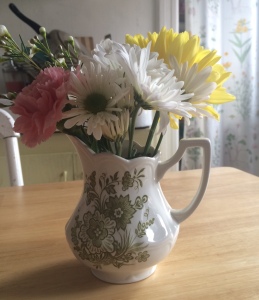
So, yesterday at the grocery store, I bought myself a little bouquet on the way to the checkout.  I’ve been meaning to for a while, because I just got this little milk pitcher at the Goodwill and was dying to put flowers into it. (I will never use a milk pitcher as such in my life.)  So I got my flowers home, hacked off the stems and put them into my new find.

The effect is exactly what I hoped it would be, and it makes me smile every time I look at them.  I think that’s why I like flowers.  They’re just happy things.  They don’t really do much, per se, but God put them in the world to make it beautiful, and I like it that way.

I don’t think we always give beauty its credence in our culture.  Things like art and music and flowers only matter if they can be instantly understood and consumed.  If a thing takes time to process, appreciate, or enjoy, we skip it.  That saddens me.  It is part of the reason I intentionally slow down sometimes.  I just turn on some music instead of the television.  I purposefully leave my phone plugged into the wall in another room.  It is important to remember that some of the best things take time.

And so I do my bit to fight against the tide of the instantaneous:   I put flowers on my table.

Cooking · Food · Kitchen Culture · Recipes

Waffles

I am not much of a breakfast person.  I manage a piece of peanut butter toast every morning, only because I know that “it’s good for me.”  I don’t go in for eggs (I can’t get over the smell), I don’t much care about sugar, so things like French toast and pancakes don’t faze me, and being extremely finicky about how I like my bacon means I almost never make it.  (Plus, it takes a solid week for the lingering aroma of stale bacon grease to clear out of my apartment.)

For my breakfast-loving father, who would eat eggs and bacon three times a day if you’d let him, my “just coffee for me, thanks” proclivities are a source of unending disappointment.

But I do make a few exceptions.

When I was a little girl, Saturday was “waffle day” at our house.  My father found my parents’ waffle iron at a flea market in like 1978, and the thing was already ancient then.  It had one of those old-fashioned electrical cords that were covered in fabric, and it weighed about a ton.  As far as I was concerned, the waffles it produced were the best.  It made a thinner, crisper waffle with about a million tiny waffle squares, each and every one of which designed be filled to the brim with syrup.  (Every child knows that the whole point of a waffle is just to be the vehicle for as much maple syrup as possible.)  I grew up in a house where we had to have “good-for-you” cereals, which excluded the much sought-after kid varietals like Lucky Charms and Froot Loops, so waffles were as close as I ever came to candy for breakfast (another life ambition of the average five year old.)

Every Saturday in my early childhood, I remember my dad getting up and making waffles in our kitchen.  I have a lot of great memories of those Saturdays, standing on a kitchen chair in my jammies next to my father and “helping.”

I’m sure I caused way more trouble than I was worth, but to my four-year-old self, it was a great privilege to mix the batter still in the bowl.  Sometimes, my dad would even let me pour the batter onto the waffle iron.  I can still remember that distinctive, sizzling sound the batter made when it hit the hot iron, and the pretty golden color of the waffles when my dad would peel them off the dark metal and onto the serving dish.

As I got older, more babies came, life got busier, my dad’s job changed to include a lot more business trips, I was busy with school and clubs and friends and “being mature” (a hilarious illusion held by thousands of teenagers all over America), and Waffle Day went the way of the dodo.

I am a “real” adult now, with a career and place of my own, my own hobbies and friends and responsibilities.  I have lived on the other side of the world and back again.  I have developed my own rituals and personal traditions, but sometimes, I still miss those days when I was little and life was simple and Waffle Day was still a thing.

So I called my father up the other day and asked, “Dad, do you remember how you always used to make waffles when I was little on that really old waffle iron?  Do you guys still have it?”

My parents do still have that waffle iron.  It is still ancient.  It still weighs about a ton.  The old cloth cord didn’t work anymore, but my dad hunted all over the city and managed to find a replacement, so I could go over to my parents’ house and make waffles again.

We’re a little out of practice, my dad and I–the first few tries got stuck to the iron for reasons we couldn’t figure out–but that didn’t matter.

Some things are different.  I am an adult now, older than my father was when we first did this.  I don’t need to stand on a chair to see what’s going on on top of the counter.  I don’t need someone else to make sure I don’t burn myself or tell me not to put so much batter on the iron.

But some things are still the same.  It still feels like an honor to pour the batter.  The waffle iron still makes that sizzling noise when you close it.  It is still reassuring to know that if you get burned, someone’s going to be there to tell you it’ll be okay.  It still seems to take forever for the steam to stop hissing out of the sides of the closed iron.  It is still exciting to make waffles.  It is still a privilege to stand next to my daddy.

You can check out my family’s waffle recipe on the drop down menu under “Recipes.”  (It’s really not that much harder than a box mix.  I promise.)